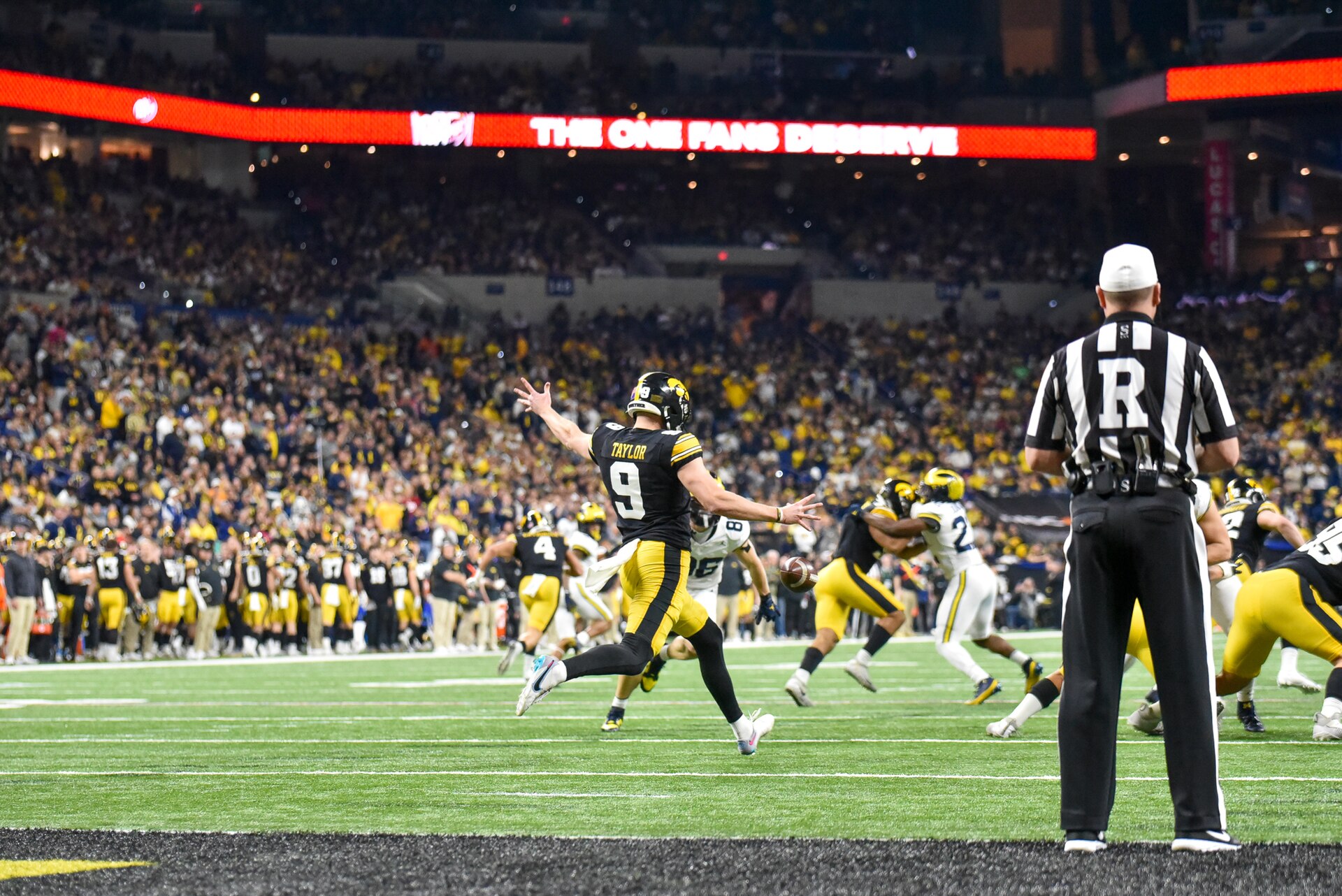
Taylor’s first major break came after he attended Prokick Australia clinics following his Australian rules football background. Prokick founders Nathan Chapman and John Smith recommended him to Iowa special-teams coordinator LeVar Woods, helping him secure an opportunity with the Iowa Hawkeyes in 2020. He won Big Ten Punter of the Year as a freshman.
Tory in the news
NFL
Tory Taylor’s Lambeau tape leaves Chicago with a placement problem to solve against Atlanta
Tory Taylor’s 53.0-yard average was the headline number in Chicago’s 31-7 loss to Green Bay, but the more useful review is what happened after the ball came down: one punt inside the 20, 27 return yards conceded and no decisive change to the Bears’ field-position cycle.
The distance was strong; the control was incompleteTory Taylor’s four-punt, 212-yard workload at Lambeau Field was his largest since Chicago’s season opener and his longest average of the 2026 season. His 53.0-yard mark included a 56-yarder, while the other punts travelled 51, 52 and 53 yards. On raw distance, it was an efficient response to a Bears offence that repeatedly failed to sustain drives. (pro-football-reference.com)
The tactical issue is that Green Bay’s return game diluted some of that distance. The Packers brought back one punt for 17 yards and recorded 27 return yards overall in Taylor’s game log, leaving Chicago with 185 net yards. That is still a 46.25-yard net average, but the profile was more about getting the ball away than consistently forcing Green Bay to start deep. (pro-football-reference.com)
The key sequence came before halftimeTaylor’s two second-quarter punts show the contrast Chicago will want to examine. A 51-yard punt was downed, giving the coverage unit the desired finish. Later, a 56-yard attempt was returned 17 yards by Matthew Golden. The latter still produced distance, but the return moved Green Bay out of the kind of starting position that turns a punt into a defensive advantage. (fandai.donguapan.workers.dev)
That distinction matters because the game was not yet gone when Taylor’s heaviest work arrived. Green Bay led 14-7 at halftime, before Christian Watson’s 53-yard touchdown catch early in the third quarter changed the game’s shape. Chicago’s punter was not responsible for the collapse, but the tape should separate successful clearance from successful field-position management. (packers.com)
Atlanta offers a different operational testThe Bears now host Atlanta on Sunday, October 18, with both teams scheduled for Week 6 action at Mercedes-Benz Stadium. Taylor’s challenge is unlikely to be simply producing another large average. It is to give Chicago’s coverage unit cleaner opportunities: directional placement, hang time and avoiding returns where the situation allows. (pro-football-reference.com)
That does not mean sacrificing field position for the sake of a low return number. Taylor’s value is partly his ability to erase poor offensive field position with distance, and his 2026 game log shows a 63-yard long already this season. The adjustment is choosing when the maximum-distance ball is the correct call and when a shorter, better-directed punt gives the defence a more favourable down-and-distance environment. (pro-football-reference.com)
A useful reset rather than a statistical warningTaylor’s season totals now sit at 12 punts for 614 gross yards across five games, with a 51.2-yard average and a 63-yard long. The numbers confirm that his leg remains a significant part of Chicago’s field-position plan. They also show why the Atlanta game is a more instructive follow-up than the raw 53.0-yard figure: Chicago needs to find out whether Taylor can pair his usual distance with more consistent placement and return suppression. (pro-football-reference.com)
The Packers’ 31-7 win made the final field-position battle look secondary, but Taylor’s workload preserved a narrower question for the Bears. If the offence again stalls, can the punt team create a genuinely difficult first possession for Atlanta rather than merely ending Chicago’s drive? That is the next development in Taylor’s 2026 season.
SourcesTory Taylor Stats, Height, Weight, Position, Draft, College | Pro-Football-Reference.comChicago Bears at Green Bay Packers - October 11th, 2026 | Pro-Football-Reference.comPackers defeat Bears, 31-7Chicago Bears at Atlanta Falcons - October 18th, 2026 - Mercedes-Benz Stadium | Pro-Football-Reference.comTory Taylor 2026 game log and season statisticsChicago Bears at Green Bay Packers — October 11, 2026 box scorePackers defeat Bears, 31-7 — Week 5 recapChicago Bears at Atlanta Falcons — October 18, 2026 scheduleHeader image: https://www.flickr.com/photos/maizenbluenation/53374068004/ (CC BY 2.0) — Wikimedia Commons · CC BY 2.0
NFL
Tory Taylor’s Week 4 value will be measured by how often Chicago’s offence stalls
With Caleb Williams ruled out and Braxton Jones unavailable, the Bears’ punter faces a more revealing test against the Jets than his workload alone may suggest.
A different kind of pressure testTory Taylor enters Chicago’s Week 4 meeting with the New York Jets as part of a familiar contingency plan, but the circumstances around him have changed. The Bears are 2-1 after beating Philadelphia 27-7, yet quarterback Caleb Williams will miss his second consecutive game with a hamstring injury and left tackle Braxton Jones is also ruled out with a knee problem. (chicagobears.com)
That combination makes Taylor’s role more consequential without necessarily making it more visible. Chicago’s offence must again operate without its starting quarterback, while its protection structure loses a starting tackle. The result could be a game in which the Bears are forced to trade attacking ambition for possession security, particularly if the Jets’ defence can prevent the run game from producing manageable third downs.
The workload has already reflected the game scriptTaylor has punted eight times through three games, but the distribution matters more than the total. He was called upon four times in the 9-3 loss to Minnesota, a game in which Chicago produced only 297 total yards, then twice in the 27-7 win over Philadelphia as the Bears’ offence found greater rhythm. His two punts against the Eagles travelled 105 yards combined, with one returned for eight yards. (nfl.com)
The contrast gives the Jets game a clear tactical shape. If Tyson Bagent — who was expected to start, although coach Ben Johnson had not formally announced the decision before Sunday — can reproduce enough of the efficiency Chicago showed against Philadelphia, Taylor may remain a secondary figure. If the backup-quarterback offence is compressed by pressure, predictable down-and-distance situations or the absence of Jones, Taylor could become central to keeping the game within Chicago’s defensive control. The starting-quarterback uncertainty was confirmed by the Bears, while league reporting had Bagent taking the majority of first-team work. (chicagobears.com)
Not a repeat of the previous Taylor storyThis is not primarily a question of whether Taylor can add another strong gross average to his season. Nor is it a continuation of the broader field-position efficiency discussion that has already surrounded his Chicago role. The more immediate issue is whether his punt opportunities arrive at useful moments, before a stalled drive turns into a short-field problem for the Bears’ defence.
Through Week 3, Taylor’s most demanding outing came against Minnesota: four punts for 195 yards, including three downed inside the 20 and a long of 63 yards. That workload showed Chicago was willing to lean on him when the offence could not sustain drives, but it also came in a low-scoring defeat. Against the Jets, the challenge is to support a conservative offensive plan without allowing repeated punts to hand New York the territorial advantage. (nfl.com)
The left side adds another variableJones’ absence is relevant to Taylor even though the two players rarely share the same headline. A replacement at left tackle can alter protection calls, launch points and the offence’s willingness to call longer-developing plays. It may also encourage Chicago to run more often or use quicker throws, choices that could either reduce Taylor’s workload or produce more fourth-down decisions if the Jets close off early-down gains.
The Bears’ official injury report lists Jones, Williams and cornerback Kyler Gordon as out, while the Jets are also missing several offensive starters, including Breece Hall and Dylan Parham. That could create a lower-possession game in which both teams place greater value on avoiding negative plays. (nfl.com)
What to watch from TaylorThe cleanest indicator will be whether Taylor is asked to rescue failed drives from awkward field position or simply finish routine possessions. Chicago’s first three games have already produced both extremes: a heavy, field-position-oriented workload in Minnesota and a largely quiet night during the Eagles win.
For Taylor, Sunday’s test is therefore about timing and repeatability rather than a headline number. Chicago does not need him to dominate the game; it needs him to prevent uncertainty at quarterback and tackle from becoming a series of short fields. If the Bears’ offence stalls, his response will help determine whether those punts merely reflect an offensive limitation or become part of a controlled plan that keeps a 2-1 team competitive while its preferred attack is incomplete.
SourcesInjury Update: Caleb Williams officially ruled out for Sunday's game vs. JetsTory Taylor 2026 Logs Stats | NFL.comOfficial NFL Injury Report for Players - Week 4 of the 2026 Season | NFL.comInjury Update: Caleb Williams officially ruled out for Sunday’s game vs. JetsGame Preview: Jets vs. Bears | 2026 Week 4Official NFL Injury Report for Players - Week 4 of the 2026 SeasonTory Taylor 2026 Logs StatsTory Taylor Stats, Height, Weight, Position, Draft, CollegeHeader image: https://www.flickr.com/photos/maizenbluenation/53374068004/ (CC BY 2.0) — Wikimedia Commons · CC BY 2.0
NFL
Tory Taylor’s Chicago value is taking shape in the space between distance and control
Tory Taylor’s 49.5-yard average has attracted the early-season attention, but Chicago’s punting plan is asking the Australian to do something more nuanced: change the field without simply chasing the longest kick.
The number that needs contextTory Taylor’s opening three games have produced the sort of headline number that draws attention to a punter: 49.5 yards per punt. But the more revealing measure of his start to 2026 is not the average alone. It is the variety of ways Chicago is using him to alter the shape of a possession.
Through September 28, Taylor had punted eight times for 402 yards, with three kicks downed inside the 20 and a long of 63 yards. The figures put him among the league’s more productive punters by gross average, but they also underline the small sample and the importance of reading his work through field position rather than ranking him solely by distance. (nfl.com)
A controlled answer to stalled drivesThe Bears did not need Taylor often in their 59-37 opening-week win over Carolina. He punted twice, and Chicago’s most memorable special-teams moment came when one of those kicks moved sharply across the field and was muffed by Panthers returner Jimmy Horn Jr. Kaden Davis recovered for Chicago, turning an awkward-looking exchange into a turnover opportunity. (chicagobears.com)
That kick was labelled a “banana ball”, but the important point for Chicago is that it was not presented as a party trick. Taylor told the Bears’ website that the technique came from Australian Rules Football, where players routinely shape the ball in flight. Special-teams coordinator Richard Hightower has also described it as one element in a broader punt package rather than a standalone novelty. (chicagobears.com)
That distinction matters. A punter who can vary the ball’s flight, angle and landing point gives the coverage unit different problems to solve. The returner may have less certainty about whether to attack the ball, wait for it or allow it to bounce. For Chicago, the potential reward is not merely a spectacular recovery; it is a more difficult return decision on every punt.
The Philadelphia game sharpened the pictureTaylor’s role was quieter in Chicago’s 27-7 win over Philadelphia on September 28. He punted twice for 105 yards, averaging 52.5, but neither kick was downed inside the 20. That result is useful precisely because it resists an easy conclusion: the Bears’ punter can produce distance without every outing becoming a pinning exercise. (pro-football-reference.com)
The tactical value is situational. When Chicago needs to flip the field, Taylor’s leg can produce the length. When the Bears want to constrain a return, the placement and hang-time choices become more important than the raw total. And when an opponent’s return structure leaves an opening, the unusual shape of a kick can become part of the pressure.
That is why Taylor’s current development is better understood as an expansion of his toolkit. His early-season average is strong, but the Bears are also asking him to make different kinds of punts look intentional: high-distance kicks, directional balls and deliveries designed to create uncertainty for the returner.
An Australian skill becoming an NFL assetTaylor arrived in Chicago with a reputation built on power and volume, after his record-setting Iowa career and a heavy workload as a rookie. His second season is beginning to show a subtler progression. The Australian background is not simply part of his biography; it is informing the way Chicago thinks about what he can do with the football.
The banana ball has supplied the visible moment, but the more meaningful development is the trust behind it. Coaches are willing to incorporate a delivery that looks unfamiliar because Taylor can execute several punt types and because the coverage unit is prepared to respond. That makes his value collective rather than cosmetic.
There is no need to overstate the start. Three inside-20 punts in eight attempts is not yet evidence of a season-long dominance, and the Bears’ high scoring output has limited Taylor’s workload. But through September 28, Chicago has found a punter capable of changing field position in more than one direction. The 49.5-yard average is the entry point. The real story is that Taylor is increasingly being asked to control the space around the punt, not merely maximise the distance of the kick.
SourcesTory Taylor Stats Summary | NFL.comGame Recap: Bears open season with record-setting victory over PanthersBears embodying Ben Johnson’s ‘no block, no rock’ mantraTory Taylor Stats, Height, Weight, Position, Draft, College | Pro-Football-Reference.comTory Taylor Stats Summary — NFL.comTory Taylor 2026 Game Logs — Pro-Football-ReferenceBears embodying Ben Johnson’s ‘no block, no rock’ mantra — ChicagoBears.comGame Recap: Bears open season with record-setting victory over Panthers — ChicagoBears.com9 interesting things said by Bears coordinators — ChicagoBears.comHeader image: https://www.flickr.com/photos/maizenbluenation/53374068004/ (CC BY 2.0) — Wikimedia Commons · CC BY 2.0

NFL
Tory Taylor’s field-position value faces a different test against Philadelphia
After a four-punt, three-inside-the-20 outing against Minnesota, Tory Taylor heads into Chicago’s Monday-night meeting with Philadelphia with his early-season role clear: make the Bears’ defensive possessions longer and more difficult to escape.
Taylor’s Minnesota outing changed the questionTory Taylor’s latest performance was not simply a matter of volume. In Chicago’s 9-3 loss to Minnesota on September 20, the Australian punter handled four attempts for 195 yards, an average of 48.8 yards, with three punts placed inside the 20-yard line. His recorded net average was 46 yards. (chicagobears.com)
That outing left Taylor with six regular-season punts for 297 yards through two games. The Bears’ official log lists three punts inside the 20, while also recording a 63-yard long and a 49.5-yard season average. (chicagobears.com) The raw sample is small, but it reflects a clear usage pattern: Chicago has not needed Taylor often in its high-scoring Week 1 win over Carolina, yet he was central once the offence stalled against the Vikings.
Philadelphia presents a different tactical problemThe next test arrives on Monday, September 28, when Philadelphia visits Soldier Field for Chicago’s Week 3 game. The Eagles are 2-0 after wins over Washington and Tennessee, while the Bears enter at 1-1. (philadelphiaeagles.com)
That makes Taylor’s task less about reproducing the exact Minnesota numbers and more about controlling where Philadelphia begins its possessions. An inside-the-20 punt can matter even when the kick is not unusually long: it compresses the field, gives the coverage unit a defined target and asks the receiving offence to build a drive over a greater distance. Taylor’s three such punts against Minnesota are therefore more relevant to Chicago’s defensive planning than his gross average alone.
The matchup also gives Chicago a reason to be selective. Philadelphia’s offence is built to punish poor field position, particularly when it can stay ahead of the chains and use its run game to dictate tempo. Taylor’s directional choices and hang time will determine whether a punt merely ends a possession or also limits the Eagles’ next one. That is a tactical assessment rather than a confirmed claim about Chicago’s internal plan; no team source has publicly assigned Taylor a specific directional target for the game.
A role defined by repeatabilityTaylor’s early 2026 figures do not yet establish a season-long ranking movement or a statistical breakthrough. They do establish a dependable starting point. His two Week 1 punts against Carolina produced 102 gross yards and 85 net yards, before the Minnesota workload more than doubled his season total. (chicagobears.com)
The important development is the contrast between games. Taylor has shown he can remain largely unused when Chicago is scoring freely, then become a field-position specialist when the offence cannot sustain drives. Against Philadelphia, that flexibility may be tested again if the Eagles’ defence limits Chicago’s possession length or if the game settles into another low-margin contest.
The Bears’ official schedule lists the Eagles game for 8:15 p.m. Eastern on Monday, September 28, at Soldier Field. (nfl.com) For Taylor, the immediate benchmark is not four punts or three inside the 20. It is whether he can repeatedly turn stalled Chicago drives into defensive opportunities without giving Philadelphia a short field.
SourcesTory TaylorEagles announce 2026 scheduleNFL 2026 Chicago Bears Schedule | NFL.comChicago Bears 2026 schedule — Chicago BearsPhiladelphia Eagles announce 2026 scheduleHeader image: https://www.flickr.com/photos/maizenbluenation/53374068004/ (CC BY 2.0) — Wikimedia Commons · CC BY 2.0

NFL
Tory Taylor’s spin gives Chicago a matchup-specific pressure point against Minnesota
Tory Taylor’s unusual sideways rotation has moved from a training-camp curiosity to a documented turnover mechanism. Against Minnesota, Chicago’s punt plan can now target how the Vikings align and track the ball rather than simply asking Taylor to kick long.
The punt is now part of the matchup planTory Taylor’s Week 1 punt against Carolina did more than flip the field. Its sideways rotation caused Panthers returner Jimmy Horn Jr. to muff the ball, with Chicago recovering at the Carolina 28. The Bears later described the delivery as a punt that “spun sideways”, while Chicago coach Ben Johnson said the team had worked on the ball throughout camp. (amp.nfl.com)
That matters because Minnesota’s own Week 2 preview identified Taylor’s spin as a tactical factor ahead of Sunday’s game at Soldier Field. Vikings special-teams coordinator Matt Daniels reportedly described the delivery as a unique spin that disrupted a returner trying to track the ball and fair-catch it. This is no longer only a story about Taylor’s leg strength or hang time; an opponent has now acknowledged the design itself. (vikings.com)
What changes against MinnesotaMinnesota’s return unit should therefore be preparing for a decision problem, not just a distance problem. A conventional punt gives the returner a cleaner read: locate the nose of the ball, establish the catch point and decide whether to field it or signal for a fair catch. Taylor’s sideways movement can make that sequence less stable, particularly when the ball is falling across the returner’s body or moving away from the initial tracking line.
The key point is not that every Taylor punt will generate a muff. That would overstate one play. The Week 1 numbers were modest in volume — two punts for 102 yards, with a 54-yard long punt and 42.5 net average — and the turnover came from a single unusual delivery rather than a repeatable statistical trend. (nfl.com) But Chicago now has evidence that the technique can affect possession, and Minnesota has evidence that it must account for the possibility.
Field position and turnover pressure work togetherThe broader value is how the Bears can pair Taylor’s punt design with coverage discipline. If Minnesota chooses a conservative fair-catch posture, Chicago may accept a shorter return opportunity in exchange for a harder catch. If the Vikings attempt to attack the ball, the Bears’ coverage players can treat the return as a live turnover situation rather than simply a field-position phase.
That creates a useful complement to Chicago’s defensive identity. The Bears recovered two fumbles and made an interception in the 59-37 win over Carolina, but the Taylor-created takeaway was the only one directly manufactured by the punt itself. (vikings.com) Against Minnesota, a repeat attempt would be most valuable when the Vikings are already backed up or when a short punt could force them to start a possession in a compressed part of the field.
A weapon, not yet a systemThere is still a distinction between having a specialised delivery and building an entire return strategy around it. Taylor’s 2026 regular-season sample is only two punts, and Minnesota’s preview confirms attention on the technique without confirming that the Vikings will change return personnel or assignment structure. (nfl.com)
The immediate development is that Chicago can now call the punt with a specific opponent in mind. Taylor’s role has expanded from producing distance to controlling the returner’s visual and technical workload. Minnesota knows the spin is coming; Chicago’s advantage will depend on whether Taylor can reproduce the shape, and whether the coverage unit is positioned to punish hesitation.
SourcesChicago Bears punter Tory Taylor's spinning punt leads to fumble against PanthersMinnesota Vikings at Chicago Bears Week 2 Game PreviewTory Taylor 2026 Logs Stats | NFL.comMinnesota Vikings: Vikings at Bears Week 2 Game PreviewChicago Bears: Game Recap — Bears open season with record-setting victory over PanthersNFL: Tory Taylor’s spinning punt leads to fumble against PanthersNFL: Tory Taylor 2026 Logs StatsHeader image: https://www.flickr.com/photos/maizenbluenation/53374068004/ (CC BY 2.0) — Wikimedia Commons · CC BY 2.0
NFL
Brett Thorson’s first divisional road test is about denying Chicago easy field position
Minnesota’s rookie punter enters his first NFC North away game with a simple assignment: make Chicago’s explosive offence work the long field, especially after the Bears’ 59-point opener.
The first real pressure pointBrett Thorson’s first NFL road appearance arrives with a more defined tactical brief than his debut. Minnesota visits Chicago on Sunday, September 20, for the Bears’ home opener at Soldier Field, with both teams entering 1-0 and the home side fresh from a 59-37 win at Carolina.
Thorson’s opening numbers provide a useful baseline rather than a finished evaluation. He punted four times for 161 yards against Green Bay, averaging 40.2 yards with a 36-yard net. Three punts were placed inside the 20, with no touchbacks, while Chicago’s official Week 2 preview identifies a Bears attack that scored in every quarter of its opener and produced 291 rushing yards. (vikings.com)
The tactical value is in the miss, not the maximumThe key question for Thorson is not whether he can produce a long punt at Soldier Field. It is whether Minnesota can use his directional control to remove the short-field possessions that made Chicago so dangerous in Week 1.
The Bears’ opener included six rushing touchdowns, with D’Andre Swift and Kyle Monangai both reaching 100 yards and Caleb Williams adding 65 on the ground. That production creates an obvious defensive problem, but it also changes the value of every punt. A conventional kick that allows a clean return, or a punt that gives Chicago possession near midfield, can turn the Bears’ tempo into another scoring opportunity before Minnesota’s defence has settled.
Thorson’s three inside-20 punts against Green Bay suggest Minnesota is willing to prioritise placement over raw distance. That approach matters more against Chicago than it did in a game where the Packers were limited by injuries and a depleted running-back group. The Vikings’ own preview described the Bears as a more demanding test, particularly after Green Bay’s backup-heavy rushing attack produced only 66 yards. (vikings.com)
The return-unit problem is part of the puntChicago is also not a neutral opponent in the kicking game. Minnesota’s preview specifically highlighted Tory Taylor’s unusual punt spin, which contributed to a muff by Carolina cornerback Jaycee Horn. That is not merely a returner issue: it means Thorson’s hang time, trajectory and coverage timing will be judged against a specialist whose punts are already affecting how opponents handle the ball.
For Thorson, the response should be disciplined rather than theatrical. A high, well-directed punt that gives Minnesota’s coverage unit time to build its lanes may be more valuable than chasing an extra five yards and allowing Chicago a manageable return. The Vikings do not need him to win the game on his own. They need him to keep the Bears from shortening the field while Minnesota’s defence deals with an offence capable of scoring quickly through both its run design and quarterback movement.
Why Soldier Field changes the evaluationThis is Thorson’s first meaningful divisional road checkpoint, not because one game will define his season, but because the context removes some of the protection around a debut. He now has to operate in a rivalry environment, against a high-output offence, with the opponent’s return strategy already drawing attention in the scouting report.
The Vikings have also confirmed Carson Wentz will start at quarterback after Kyler Murray progressed through concussion protocol. That could increase the importance of field position if Minnesota’s offence is managed more conservatively early, particularly while Wentz resumes the starting role. (vikings.com)
A successful afternoon for Thorson may therefore look quieter than his college reputation or a booming punt suggests. The useful indicators are likely to be whether he can sustain the Week 1 inside-20 rate, avoid touchbacks, limit returnable mistakes and consistently force Chicago to begin drives away from its preferred tempo.
That is the real development to track on September 20. Thorson has already established that Minnesota trusts his complete specialist profile. Against Chicago, the next step is showing that profile survives a divisional road environment where one poor punt can give an explosive offence the exact field position it wants.
SourcesBrett ThorsonMinnesota Vikings at Chicago Bears Week 2 Game PreviewBrett Thorson | Minnesota Vikings official roster and statisticsVikings at Bears Week 2 Game CenterVikings at Bears Week 2 Game PreviewGame Preview: Vikings vs. Bears | 2026 Week 2Brett Thorson NFL and PFF statisticsHeader image: AI-generated editorial illustration.
NFL
Tory Taylor’s banana ball is becoming a real weapon in Chicago’s special-teams redesign
The Australian punter’s unusual Week 1 delivery helped create a turnover, and Bears coordinator Richard Hightower says it is only one part of Taylor’s expanding tactical repertoire.
A strange punt with a practical payoffTory Taylor’s banana ball has already moved beyond novelty in Chicago. In the Bears’ 59-37 season-opening win over Carolina on September 13, the Australian punter used the sideways-spinning, bending delivery on a 48-yard punt that Panthers returner Jimmy Horn Jr. muffed. Chicago recovered through Kaden Davis, turning an unusual flight path into a sudden possession swing. (chicagobears.com)
The timing mattered. Carolina had levelled the game at 21-21 midway through the second quarter, and although the Bears ultimately settled for a field goal after the recovery, the play disrupted a Panthers return opportunity in a contest that became an offensive shootout. Carolina special-teams coordinator Tracy Smith described the kick as difficult to field because it does not rotate like a conventional spiral punt. (panthers.com)
Hightower’s message: this is part of the packageChicago’s special-teams coordinator Richard Hightower put the play in sharper context ahead of Sunday’s home opener against Minnesota. Speaking on September 17, Hightower said the banana ball was “just one of many punts” in Taylor’s repertoire, rather than a one-off trick deployed for attention. (chicagobears.com)
That distinction is important for a Bears unit being reshaped under head coach Ben Johnson. The value is not simply that Taylor can produce a ball which looks unfamiliar on television. It is that Chicago can vary the punt’s flight, rotation and return-point picture, forcing an opponent’s return team to prepare for more than a standard spiral, end-over-end punt or directional kick.
The Panthers’ own explanation underlined the practical challenge. Smith said the ball spins more like a kickoff around its axis, with a different visual pattern and movement through the air. That makes the returner’s job less about memorising a trick and more about judging an unfamiliar ball under game pressure. (panthers.com)
Taylor’s leg still anchors the approachThe banana ball grabbed the highlight, but Taylor’s broader Week 1 output gave the experiment a strong statistical base. He punted twice for 102 yards, averaging 51.0 yards with a long of 54, while Carolina recorded 17 return yards. The Bears did not need him often in a game where the offence scored 59 points, but both punts were substantial field-position plays. (pro-football-reference.com)
That limited workload also keeps the evaluation appropriately narrow. One muff does not prove the delivery will regularly generate turnovers, and Taylor’s 51.0-yard average cannot by itself define Chicago’s special-teams performance. The verified development is more specific: the Bears have a punter capable of changing the return problem from snap to snap, and the coaching staff is openly treating that versatility as useful rather than decorative.
A new question for MinnesotaThe next test comes at Soldier Field on September 20, when Chicago hosts Minnesota in its first home game of the season. The Vikings’ return unit will have had time to study the Carolina tape, which should make the matchup more revealing: can Taylor’s variation still create hesitation once the opponent knows what is coming?
The answer may not be measured only in another muff. A returner who adjusts his alignment, takes fewer chances or chooses a fair catch has still been influenced by the threat. For Taylor, that is the larger opportunity. His Australian-rules background has supplied Chicago with a distinctive tool, but Hightower’s comments suggest the Bears see it as one element in a complete punting menu. (chicagobears.com)
Taylor’s banana ball has therefore earned a place in the tactical conversation after just one meaningful use. It is no longer simply an Australian curiosity. In Chicago’s redesigned special-teams approach, it is a pressure point: a delivery that can make the returner hesitate, change the coverage picture and potentially hand the Bears possession.
SourcesBears embodying Ben Johnson’s ‘no block, no rock’ mantraThree takeaways from coordinators Thursday, including grading Monroe Freeling's debut9 interesting things said by Bears coordinators in advance of home openerTory Taylor Stats, Height, Weight, Position, Draft, College | Pro-Football-Reference.comBears embodying Ben Johnson’s ‘no block, no rock’ mantra9 interesting things said by Bears coordinators in advance of home openerThree takeaways from coordinators Thursday, including grading Monroe Freeling’s debutTory Taylor StatsHeader image: https://www.flickr.com/photos/maizenbluenation/53374068004/ (CC BY 2.0) — Wikimedia Commons · CC BY 2.0
NFL
Tory Taylor’s 2026 value will be measured beyond the big punt as Bears reshape return unit
Tory Taylor begins his third NFL season as Chicago’s established punter, but Kalif Raymond’s arrival gives the Bears a new way to turn his distance into field position.
Taylor’s job is secure — the measuring stick is changingTory Taylor enters Week 1 with the clearest specialist status of his young NFL career. The Chicago Bears included the Australian punter on their initial 53-man roster announced on August 30, confirming him as the club’s settled option heading into his third season. (chicagobears.com)
That security matters because Taylor’s 2025 campaign was already a franchise benchmark. He averaged 47.8 yards across 60 punts, improving on his 47.7-yard rookie mark and setting Chicago’s single-season gross-punting record. His longest punt travelled 69 yards, while 21 kicks landed inside the opposition’s 20-yard line. (nfl.com)
The headline number is explosive. The more revealing number is the net average: 40.4 yards in 2025, down from 41.6 as a rookie. Taylor’s gross average rose, but the Bears did not get the same return in usable field position. Opponents brought back 26 of his punts for 306 yards, compared with 41 returns for 422 yards in 2024. (nfl.com)
A different return threat behind himThat is where Chicago’s revamped return unit could alter the way Taylor’s work is judged. The Bears added veteran Kalif Raymond in free agency and also drafted Zavion Thomas, giving special teams coordinator Richard Hightower two dynamic options with the ball in their hands. Raymond has averaged 11.3 yards across 132 career punt returns and earned second-team All-Pro honours in 2022 and 2024. (chicagobears.com)
Raymond’s arrival does not change Taylor’s punting assignment, but it can change the value of the entire exchange. A returner who consistently makes the first defender miss can punish a coverage unit for allowing even a modest return lane. Conversely, a disciplined coverage team and a reliable returner can make a 47- or 48-yard punt functionally longer by limiting the opponent’s answer.
The Bears have also described Raymond as a major part of their offensive plans, so his precise workload on returns may vary. Thomas adds another layer of competition after posting a 4.28-second 40-yard dash at the 2026 NFL Combine and entering the league with substantial college return experience. (chicagobears.com)
The 2026 test is net control, not just distanceTaylor’s 2025 figures suggest a punter capable of flipping the field but not yet beyond scrutiny. Twenty-one punts inside the 20 is a strong platform, yet it was 13 fewer than his rookie total despite 22 fewer attempts. His net average also slipped by 1.2 yards. Those figures do not make last season a failure; they show why gross distance alone cannot tell the full story. (nfl.com)
With Raymond and Thomas joining the coverage-and-return equation, Taylor’s 2026 value should be assessed through the complete sequence: launch, hang time, coverage, return decision and final field position. The Bears now have more athleticism available to create positive outcomes after the catch, but that places greater emphasis on Taylor’s ability to pair power with placement and control.
For an Australian punter already holding Chicago’s gross-distance record, the next step is less about proving he can hit the ball a long way. That part is established. The Week 1 question is whether Taylor and the reshaped special-teams unit can turn those heavy strikes into shorter fields, fewer return yards and a stronger net result.
SourcesChicago Bears announce roster movesTory Taylor Career Stats | NFL.comRichard Hightower thrilled with additions of Kalif Raymond, Zavion ThomasBears land draft class that fits their competitive DNAChicago Bears announce roster moves: initial 53-man rosterTory Taylor career statistics — NFL.comTory Taylor 2025 game logs — NFL.comRichard Hightower thrilled with additions of Kalif Raymond, Zavion ThomasBears 2026 training camp position preview: ReceiverHeader image: https://www.flickr.com/photos/maizenbluenation/53374068004/ (CC BY 2.0) — Wikimedia Commons · CC BY 2.0
NFL
Tory Taylor is part of an Australian punting wave the NFL can no longer treat as a novelty
As the 2026 season approaches, Tory Taylor’s place on Chicago’s active roster helps show how Australian specialists have become a durable NFL presence across several clubs.
The conversation has changedFor years, Australian punters in the NFL were discussed as intriguing exceptions: gifted kickers arriving from a distant football culture, usually needing time to prove they could handle the league’s operation, pressure and tactical demands. That framing is becoming harder to sustain in 2026.
The reason is visible in the final roster picture. With the regular season beginning this week, Australia has four established punting options spread across different NFL teams: Michael Dickson remains Seattle’s long-term specialist, Cameron Johnston has won Pittsburgh’s punting job, Jeremy Crawshaw enters his second Denver season as the Broncos’ starter, and Tory Taylor is on Chicago’s active roster. Brett Thorson’s selection in Minnesota adds another Australian name to the wider discussion, although the central story is the number of credible specialists already occupying real NFL roles. Recent Australian coverage has consequently treated the group as a pipeline rather than a collection of isolated stories. (foxsports.com.au)
Taylor is the useful test caseThe cleanest lens for that shift is Tory Taylor. The Bears have not carried him into 2026 as a speculative camp arm or a developmental stash. Chicago’s official roster lists Taylor as its active punter, while the NFL’s roster page also identifies him as active. The Bears’ initial 53-man roster likewise included him among the team’s specialists. (nfl.com)
That matters because punters occupy a particularly unforgiving roster niche. There is generally one job, one game-day specialist and little room for a developmental compromise. A club can experiment with a backup quarterback or carry a young receiver behind veterans; it does not usually carry two genuine punters for long. Taylor’s continued place in Chicago therefore represents a direct decision: the Bears believe his value is ready for the regular season, not merely worth exploring.
His preseason workload offered a current reminder of what Chicago is backing. Across three games, Taylor punted 12 times for 611 yards, with a 50.9-yard gross average and three punts inside the 20, according to the NFL’s 2026 logs. Those numbers are preseason evidence rather than a forecast of regular-season performance, but they provide a concrete starting point as the Bears prepare for Week 1. (nfl.com)
Established does not mean identicalThe Australian group is not successful because every punter has followed the same route or carries the same status. Dickson is the veteran anchor. Seattle’s 2026 roster coverage describes him as one of the club’s longest-continuously-tenured players and confirms the Seahawks are returning the same specialist trio for a fourth consecutive season. (seahawks.com)
Johnston represents another form of durability. Pittsburgh’s initial 53-man roster names him as the Steelers’ punter after his return to the club, giving him a settled job rather than another open-ended tryout. (steelers.com) Crawshaw is the younger success story: Denver retained him after a 2025 season in which he played all 17 regular-season games, set a franchise record for season punt average and earned PFWA All-Rookie recognition. The Broncos’ 2026 roster announcement again lists him as the starter. (denverbroncos.com)
That range is the important point. Australian punters are appearing as a veteran constant, a returning starter, a second-year incumbent and an early-career player trying to establish himself. The pathway is no longer being judged solely by whether one exceptional player can survive.
Why the discussion matters nowThe timing gives the trend more weight. September roster decisions are the league’s hard checkpoint: camp invitations and preseason opportunities have been replaced by active-roster jobs, weekly game plans and the risk of being challenged every Sunday. Taylor has cleared that checkpoint in Chicago, while Dickson, Johnston and Crawshaw have done so in Seattle, Pittsburgh and Denver. (chicagobears.com)
That does not prove Australia will dominate the punting market, nor does it guarantee that every name remains in place all season. NFL rosters are fluid, and performance, injury and transaction pressure can change the picture quickly. But the opening-week evidence supports a more durable conclusion: Australian specialists are now entering an NFL season as a recognisable working class of players across multiple clubs.
Taylor is central to that argument because Chicago is not offering him a ceremonial role. The Bears are asking him to execute immediately, in a league where field position is a weekly calculation and one poor punt can flip a game. If he delivers, the result will not simply be another chapter in Taylor’s development. It will strengthen the broader idea that Australian punters have moved from novelty act to dependable NFL infrastructure.
SourcesNFL 2026: Australians in NFL this season, Jordan Mailata, Michael Dickson, Cameron Johnston, Tory Taylor, Aussie players on practice squads, teams, season previewChicago Bears 2026 Player Roster | NFL.comTory Taylor 2026 Logs Stats | NFL.comMichael DicksonSteelers initial 2026 53-man rosterDenver Broncos Rosters | Denver Broncos – denverbroncos.comTeam Roster | Chicago Bears Official WebsiteChicago Bears 2026 Player RosterNFL.com — Tory Taylor 2026 Logs StatsChicago Bears — 2026 Initial 53-Man RosterHeader image: https://www.flickr.com/photos/maizenbluenation/53374068004/ (CC BY 2.0) — Wikimedia Commons · CC BY 2.0
NFL
Tory Taylor’s Bears security is built on role clarity — and one carefully timed roster exemption
As the NFL’s 53-man deadline arrives on Sunday, Chicago’s Australian punter shows why specialist certainty and roster mathematics are now inseparable.
The deadline has changed the questionTory Taylor is not entering Sunday, August 30, as a fringe player waiting for one final punt to save his season. The Chicago Bears list the Australian punter as active, and their depth chart continues to show him as the team’s first-choice punter. The question is no longer whether Taylor can win the job. It is how the Bears use every available roster mechanism around a player whose role is already settled. (chicagobears.com)
That distinction matters across the league. Clubs must reduce their rosters to 53 players by Sunday’s deadline, with the compressed timetable leaving front offices little room to separate genuine position battles from straightforward role decisions. The Bears’ football operations staff have less than 24 hours after their preseason finale against Tennessee to complete the initial roster, following a schedule adjustment connected to the Week 1 49ers-Rams game in Australia. (nfl.com)
That is why the specialist conversation has sharpened now. At this point of the calendar, teams are not simply asking who produced the longest punt or the loudest preseason moment. They are asking which jobs require certainty, which players can be exposed to waivers, and where a roster designation can create room without weakening the team’s functional core.
Taylor’s case is the clean version of the specialist equationTaylor’s value is unusually easy for Chicago to define. He is the punter, not a developmental defensive back, a position-conversion project or a player whose path depends on injuries elsewhere. The Bears’ official roster lists him at No. 19 with an active designation, while the club’s player profile records 60 punts in 2025 for a 47.8-yard gross average and 21 kicks placed inside the 20-yard line. Those numbers are supporting evidence, not the whole case: the greater security comes from the absence of uncertainty around his role. (chicagobears.com)
Chicago also placed an international-player roster exemption on Taylor on May 21. That move allowed the Bears to carry an additional player during the offseason roster phase, rather than forcing Taylor immediately into the standard 90-player limit. The NFL’s roster guidance makes the mechanism clear: an exemption player does not count against the active/inactive 53-man roster, while the league’s international-player rules are designed to provide extra developmental capacity. (chicagobears.com)
The important nuance is that this is not a permanent free pass from the 53. Once Chicago finalises its regular-season roster, Taylor’s place still has to be accounted for if he is active. The exemption’s value is earlier and more practical: it gave the Bears room to add or retain another player through the offseason and preseason evaluation window, while preserving a specialist whose place was never likely to hinge on a camp flashpoint.
The maths can protect certainty — but it cannot replace itThis is where Taylor becomes a useful Australian lens on a league-wide trend. Specialist roles are narrow, but they are also highly visible in roster construction. A team can carry one punter, one kicker and one long snapper because those jobs have defined ownership. That certainty allows decision-makers to spend marginal roster spots elsewhere, particularly on backup offensive linemen, coverage players and developmental athletes whose roles may overlap.
The exemption therefore does not make Taylor’s roster place automatic. It makes the sequencing cleaner. Chicago could carry him as an extra offseason player, evaluate the rest of the squad, and arrive at cutdown day with a clearer picture of which conventional roster spots were genuinely available. That is roster flexibility, not roster immunity.
The same logic is appearing throughout the NFL’s cutdown discussion. League coverage has framed the deadline as a mass reshaping of rosters, with roughly 1,184 players set to lose their jobs before the initial 53s are submitted. Teams will then turn quickly to practice squads, which can include an additional international player under the league’s current rules. (amp.nfl.com)
Taylor sits on the safer side of that equation because Chicago knows exactly what it needs from him. His path is not being rescued by punt distance at the last second. It is being reinforced by performance, a defined specialist job and a roster tool that gave the Bears extra room while they judged everyone else. On a day when the NFL’s margins are measured in waiver claims and spare slots, that may be the clearest form of security available.
SourcesTeam Roster | Chicago Bears Official WebsiteNFL training camp roster FAQs: Defining injured reserve, PUP list, NFI and more | Latest NFL News, Analysis & Updates | NFL.comTransactions | The Official Website of the Chicago Bears2026 NFL 53-man roster deadline: Cut candidates, trade targetsChicago Bears team rosterChicago Bears depth chartChicago Bears transactionsNFL training camp roster FAQsNFL International Player PathwayRyan Poles talks roster cutdown day
NFL
Tory Taylor’s Bears case is now about certainty, not distance
Chicago’s second preseason game did not produce a punting showcase. That is precisely why Tory Taylor’s evaluation is shifting: with the 53-man deadline less than a week away, the Bears must decide whether his total specialist value justifies one precious roster spot.
The clock is changing the questionThe Bears’ 27-9 loss to Cincinnati on Saturday, August 22, was less a showcase for fringe specialists than a reminder of how quickly the preseason evaluation window is closing. Chicago used most of its starters for limited work after a disrupted practice week, while the game itself became another piece of a much larger roster puzzle. (chicagobears.com)
That puzzle reaches its hard deadline on Sunday, August 30, when every club must reduce its active/inactive list to 53 players by 6pm New York time. The third preseason weekend runs from August 27-29, leaving teams only a handful of days to settle the final decisions. (nfl.com)
That timing matters for Taylor because the final question is no longer simply whether he can hit a 60-yard punt. It is whether the Bears know exactly what they are getting from him — and whether that package is valuable enough to protect when every bottom-of-roster place is being challenged by a linebacker, defensive back, interior lineman or core special-teamer.
Gross yardage is only the opening lineTaylor’s physical appeal has never been difficult to identify. Chicago’s official profile credits him with a 47.8-yard average and 41.1-yard net average across his Bears career, the highest gross and net marks in franchise history among punters with at least 100 attempts. His 2025 season included 60 punts, a 47.8-yard gross average and 21 kicks downed inside the 20. (chicagobears.com)
But those numbers also show why raw distance cannot be the entire evaluation. A punt that travels further but out-runs its coverage can trade field position for return opportunity. A lower, controlled ball to the sideline can be more useful than a booming kick that becomes a touchback. The Bears are weighing placement, hang time, coverage coordination and the repeatability of the operation — not just the longest ball Taylor can produce in a warm-up environment.
The wider roster-building logic supports that approach. Former NFL executive Scott Pioli has described the final five to 10 roster places as frequently belonging to core special-teams contributors, while stressing that clubs continually compare their own fringe players with possible upgrades elsewhere. (nfl.com)
Taylor’s hidden value sits in the operationFor Chicago, Taylor’s case also includes the work that rarely survives into a highlight package. A dedicated punter must be reliable as the holder, comfortable handling the snap-to-kick timing with Cairo Santos, and dependable when protection or field position changes the call. Those details are part of the job’s roster value because a punter is not merely an emergency leg; he is one component of the field-goal unit, punt team and weekly game-plan structure.
That creates a sharper test than distance. Can Taylor consistently execute the planned ball — directional, high, short, long or designed to eliminate a return — while keeping the operation clean? Can the Bears trust him in a tight fourth quarter without adjusting the rest of the special-teams structure around him? If the answer is yes, the dedicated punter spot becomes easier to justify. If the performance is merely adequate, roster mathematics becomes more uncomfortable.
What Chicago must learn nextThe Cincinnati recap did not identify a major Taylor storyline, and that itself is instructive: specialist evaluation is often built from a collection of quiet reps rather than one headline play. The Bears’ final preseason appearance should therefore be read through role certainty. Taylor does not need to win the roster with distance alone. He needs to remove doubt from the full job description.
For the Australian, that means the next meaningful measure is not the biggest punt on the stat sheet. It is whether Chicago’s coaches can pencil in Taylor, Santos and the long-snapper as a settled unit, then spend the final roster decisions elsewhere. With the cutdown arriving on August 30, certainty is the currency Taylor must earn.
SourcesGame Recap: Bears fall to Bengals in second preseason game2026-27 National Football League important datesTory TaylorNFL preseason: An executive's guide to constructing the 53-man roster | Latest NFL News, Analysis & Updates | NFL.comAbout Tory
Tory Taylor is an Australian NFL punter for the Chicago Bears. Born in Melbourne, Victoria, he developed through Australian rules football and Prokick Australia before moving to the United States to play college football at Iowa. Taylor became one of college football’s most accomplished punters, winning the 2023 Ray Guy Award and earning unanimous All-American honours. The Bears selected him 122nd overall in the fourth round of the 2024 NFL Draft. As of August 18, 2026, he is listed as active o…
Tory Taylor was born in Melbourne, Victoria, Australia, on October 7, 1997, and attended Haileybury College. His sporting background was Australian rules football rather than American football. He later attended Prokick Australia, where his punting potential was identified and developed. Prokick founders Nathan Chapman and John Smith helped connect him with Iowa’s programme, leading to his move to the United States in 2020.
Taylor immediately became Iowa’s starting punter as a true freshman and won Big Ten Punter of the Year, while also receiving first-team All-Big Ten and Freshman All-American recognition. Over four seasons with the Hawkeyes, he became known for distance, directional control and his ability to flip field position. He finished his Iowa career with 295 punts for 13,657 yards, a 46.3-yard career average and 103 punts of at least 50 yards. His punt total and punting yardage were Iowa records, while his 2023 season established NCAA records for single-season punting yards and single-season average.
Taylor’s 2023 campaign produced 4,479 punting yards from 93 punts at a 48.2-yard average. He won the Ray Guy Award as the nation’s outstanding collegiate punter and was named a unanimous All-American. Chicago selected him with the 122nd pick in the 2024 NFL Draft, making him one of the highest-drafted punters in recent NFL history.
Taylor wears number 19 for the Bears and remains the club’s active punter as of August 18, 2026. His NFL role is to control field position through hang time, distance, directional punting and placement inside the opponent’s 20-yard line. ESPN lists him as a 2024 fourth-round selection from Iowa, while the Bears’ official roster lists him at 6 feet 4 inches and 225 pounds.
At Iowa, Taylor recorded 295 punts for 13,657 yards, averaging 46.3 yards per punt, with 103 punts travelling at least 50 yards. His 2023 season included 93 punts for 4,479 yards at a 48.2-yard average. Iowa identifies the 2023 punting-yardage total and average as NCAA records, and his 40-plus-yard average in 43 career games as another NCAA record. His major honours include the 2020 and 2023 Big Ten Punter of the Year awards, first-team All-Big Ten honours in 2020 and 2023, and the 2023 Ray Guy Award.
Taylor’s defining college moment was his record-setting 2023 season, when he produced 4,479 punting yards and a 48.2-yard average. Another notable performance came at Penn State in 2023, where he averaged 52.3 yards on seven punts for 366 yards. His selection by Chicago with pick 122 in the 2024 NFL Draft marked the transition from Australian rules football convert to professional NFL punter.
Get Tory Taylor updates
Local start times, yesterday’s best performances and the major stories worth opening.
